


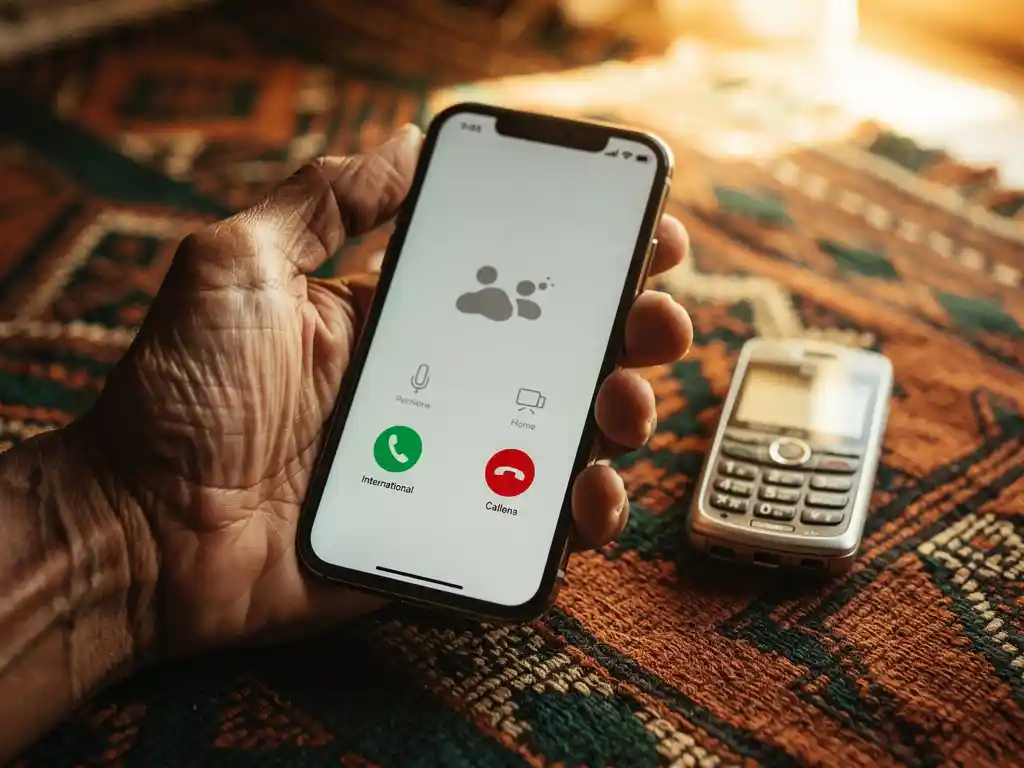
When you’re living abroad and want to stay close to family back home, the question of how to make international calls comes up quickly. Two options dominate most conversations: WhatsApp, which billions of people already use, and dedicated international calling apps built specifically for reaching phones across borders. Both work, but they work very differently, and choosing the wrong one can cost you more time, money, and frustration than you expect.
This guide breaks down the real differences between the two so you can make an informed choice—whether you’re calling family across town or loved ones on the other side of the world.
What’s the difference between WhatsApp and international calling apps?
The key difference is this: WhatsApp requires both people to have the app installed and an active internet connection. International calling apps use your internet connection to place a call directly to any phone number, including regular mobile and landline numbers, with no app or internet required on the receiving end.
WhatsApp is a messaging platform that added voice and video calling as extra features. It works brilliantly when both parties are tech-savvy and connected. International calling apps, on the other hand, are built from the ground up to bridge the gap between someone with internet access and someone without. That distinction changes everything when you’re trying to reach a parent in a rural village or an elderly relative who uses a basic mobile phone.
When does WhatsApp fall short for international calls?
WhatsApp falls short when the person you’re calling doesn’t have a smartphone, doesn’t have a reliable internet connection, or simply doesn’t use the app. In these situations, the call cannot happen at all, regardless of how good your own connection is.
Beyond the technical barrier, WhatsApp calls can be inconsistent in quality when one side has a weak or unstable connection. Dropped calls, delays, and choppy audio are common complaints for people calling into regions with limited mobile data infrastructure. There are also situations where WhatsApp is restricted or throttled by local network providers in certain countries, making it unreliable even when both parties have smartphones. For diaspora communities calling into parts of Africa, these limitations are not edge cases—they are everyday realities.
How do international calling apps connect calls without the internet on the other end?
International calling apps use a technology called Voice over Internet Protocol (VoIP), combined with traditional telephone network routing. Your voice travels over the internet from your device to the app provider’s servers, which then convert and forward the call through local telephone networks to reach the recipient’s phone number directly.
This means the person you’re calling receives a regular incoming phone call on their mobile or landline. They don’t need data, Wi-Fi, or any app. From their perspective, someone is simply calling their number. The entire technical process happens invisibly on your end, handled by the calling app’s infrastructure. This is what makes dedicated international calling apps so practical for reaching family members who use basic phones or live in areas where internet access is limited or expensive.
Which is cheaper: WhatsApp calls or international calling apps?
WhatsApp calls are free when both parties have internet, but they carry hidden costs in data usage and the assumption that the recipient is connected. International calling apps charge per-minute or per-second rates, but those rates can be very affordable, and you gain the ability to reach any phone number.
The real cost comparison depends on your situation. If your family member has reliable Wi-Fi and uses WhatsApp regularly, an app-to-app call costs nothing beyond your data plan. But if you need to call a regular phone number, WhatsApp simply cannot do it. You need a calling app, and the question becomes which one offers the best rate for your destination.
For those calling family and friends across Africa from Europe or elsewhere in the world, the rates through specialist international calling apps can be very competitive. Calls to Nigeria, for example, can cost as little as €0.08 per minute, giving you around 2 hours of talk time for €10. Calls to Eritrea or Ethiopia run around €0.17 per minute, delivering roughly 58 to 59 minutes for the same amount. Sudan comes in at €0.26 per minute for about 38 minutes, while destinations like Liberia and Sierra Leone sit at €0.29 per minute for about 34 minutes. These rates make it practical to have long, meaningful conversations without watching the clock anxiously.
Should you use WhatsApp or a calling app to reach family abroad?
Use a dedicated international calling app if your family members use basic phones, have limited or unreliable internet, or simply don’t use WhatsApp. Use WhatsApp if everyone you’re calling is reliably connected, comfortable with technology, and already on the platform. For most diaspora households, the honest answer is: you need both.
WhatsApp works well for staying in touch with siblings or children who have smartphones and data. But reaching parents, grandparents, or contacts in rural areas almost always requires a calling app that can dial a regular phone number. Rather than choosing one over the other, think of them as tools for different situations. A dedicated calling app fills the gap that WhatsApp simply cannot cover, and for many people in the African diaspora, that gap is where the most important calls happen.
What features should you look for in an international calling app?
The most important features in an international calling app are transparent pricing, per-second billing, strong call quality, and the ability to reach regular phone numbers without requiring the recipient to have an app or internet connection.
Beyond the basics, here is what to look for when comparing options:
- No hidden fees or connection charges — some apps advertise low rates but add a connection fee per call that quickly adds up
- Per-second billing — this ensures you only pay for the time you actually use, not rounded-up minutes
- Coverage for your specific destinations — not all apps cover every African country with competitive rates
- Multilingual support — the app interface should be accessible in your preferred language so you always understand what you’re paying and how the service works
- Reliable call quality — look for apps with infrastructure designed for the regions you’re calling
- Weekly deals or promotions — some providers offer discounted rates on specific days, which can significantly stretch your calling budget
It also matters whether the app feels built for you. A service that understands the specific needs of diaspora communities, offers support in languages like Tigrinya, Hausa, Amharic, or Arabic, and treats you as someone who deserves to feel heard and seen makes a real difference in the day-to-day experience of staying connected.
How FroggyTalk helps you stay connected across borders
We built FroggyTalk specifically for diaspora communities who need reliable, affordable international calling without the barriers that come with mainstream apps. Here is what we offer:
- Call any phone number in Africa directly, with no app or internet needed on the other end
- Per-second billing with no hidden fees or connection charges, so every cent goes toward your conversation
- Competitive weekly deals for destinations including Nigeria, Eritrea, Ethiopia, Sudan, Liberia, Sierra Leone, and more
- Full multilingual support so everything in the app can be used in your local language, including Tigrinya, Hausa, Amharic, Arabic, French, and more
- A Radio Hub with African FM stations so you stay connected to your culture, not just through phone calls
We want you to feel heard, seen, and noticed, whether you’re calling a parent in Lagos, a sibling in Asmara, or a friend in Khartoum. Check our latest calling rates to see exactly how many minutes you get for your money, or get in touch with our team if you have questions. You can also explore our international calling service to learn more about how we connect you to the people who matter most.