


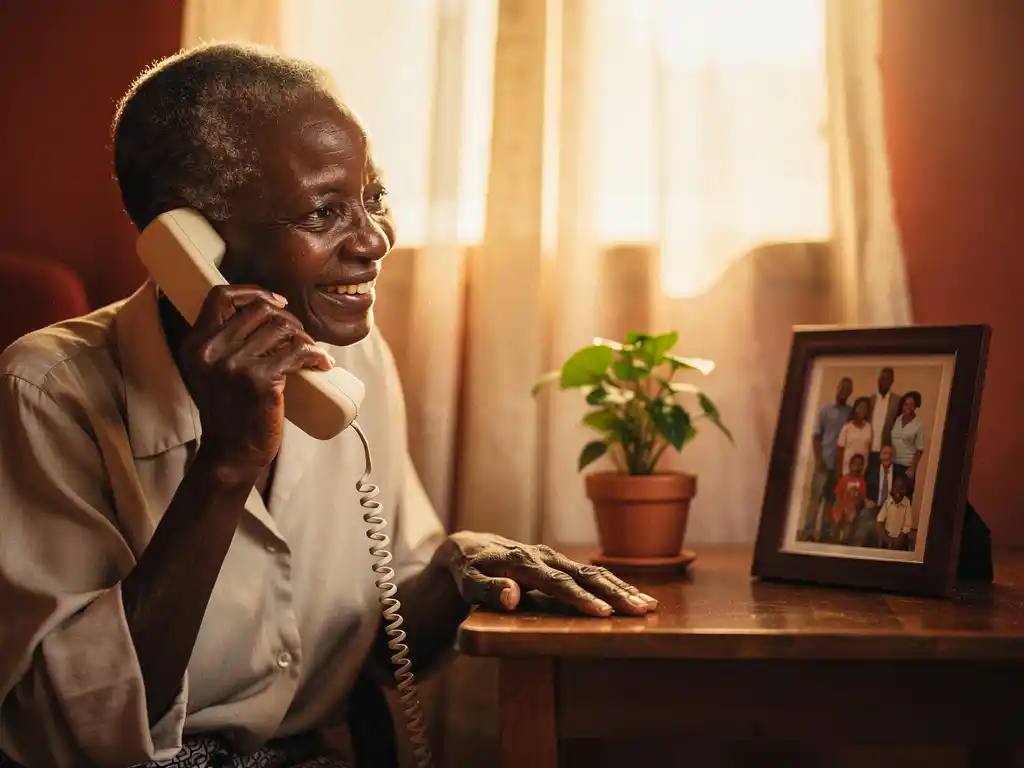
Living far from family is one of the hardest parts of the migrant experience. When your grandmother, grandfather, or elderly aunt back home doesn’t own a smartphone, staying connected can feel like an uphill battle. The good news is that distance no longer has to mean silence. With the right approach to international calling, you can keep those conversations flowing, no matter what phone is on the other end.
This guide answers the questions we hear most often from people in exactly this situation. Whether you are calling a loved one across continents or reaching a relative in a country where basic phones are still the norm, you will find practical, honest answers here.
Why is it so hard to stay in touch with elderly relatives abroad?
Staying in touch with elderly relatives abroad is hard because most modern communication tools assume both people have a smartphone, a reliable internet connection, and a degree of digital literacy. When your relative has none of these, the usual solutions simply do not work.
Video calling apps like WhatsApp or FaceTime are designed for smartphone users. If your relative has only a basic feature phone—or no phone at all beyond a shared landline—those apps are out of reach. Even when a smartphone is available, elderly relatives may find the technology confusing or intimidating, which creates an emotional barrier on top of the practical one. This is a reality faced by many diaspora communities, including those calling family in Nigeria, Ethiopia, Eritrea, Sudan, and other countries where basic mobile phones remain widespread.
There is also the question of cost. International calling from a European mobile plan can be surprisingly expensive, and the charges often catch people off guard. When you worry about the bill, you call less. When you call less, the emotional distance grows. That cycle is something many people in diaspora communities know all too well.
What are the best ways to call family who don’t have smartphones?
The best ways to call family who do not have smartphones are services that let you call a regular mobile or landline phone number directly, without requiring anything special on the recipient’s end. The person you are calling simply picks up their phone as usual.
Here are the most practical options available today:
- Internet-based calling apps that dial regular phone numbers, so your relative receives a standard incoming call on their basic phone
- Prepaid international calling cards, which are still available but often come with hidden connection fees that eat into your credit
- Calling via your mobile operator’s international add-on, though these are usually the most expensive option per minute
- Scheduled weekly calls at a fixed time, so your relative knows exactly when to expect you and can be near their phone
Of these options, internet-based apps that call regular phone numbers offer the best balance of affordability and reliability. The key is finding one that is transparent about its rates and does not add hidden connection fees on top of the per-minute cost.
How does calling a regular phone through an internet app work?
Calling a regular phone through an internet app works by converting your voice into digital data, sending it over the internet, and then connecting it to the traditional phone network in the destination country. The person you are calling receives a completely normal phone call and does not need the internet or any app.
This technology is called VoIP, which stands for Voice over Internet Protocol. On your side, you open the app on your smartphone, enter the phone number you want to reach, and press call. The app handles everything behind the scenes, routing your call through internet servers and then onto the local phone network in the destination country.
What do you need on your end?
To make this kind of call, you need a smartphone with a working internet connection, either Wi-Fi or mobile data. You also need an account with a service that supports outgoing calls to regular phone numbers. That is genuinely all that is required on your side.
What does the person you are calling need?
Absolutely nothing extra. Your elderly relative just needs their regular phone, whether it is a basic mobile or a landline. When your call comes through, it rings like any other call. There is no app to download, no account to create, and no internet needed. This is what makes this method so well suited to staying in touch with older family members who are not comfortable with technology.
Which countries are cheapest to call from Europe?
The cheapest countries to call from Europe using an internet calling app vary by provider, but rates differ significantly depending on the destination. Among African destinations, Nigeria is consistently one of the most affordable to call, while countries like South Sudan and Zimbabwe tend to have higher per-minute rates.
To give you a concrete sense of what affordable international calling looks like, here is a breakdown of weekly calling deals we offer, showing how many minutes you get for your money:
- Nigeria on Saturdays: around 2 full hours of talk time for roughly 10 euros, making it the most affordable destination in our range
- Ethiopia on Sundays: approximately 59 minutes for around 10 euros
- Eritrea on Sundays: approximately 58 minutes for around 10 euros
- Sudan on Fridays: approximately 38 minutes for around 10 euros
- Liberia and Sierra Leone on Saturdays: approximately 34 minutes for around 10 euros each
- South Sudan and Zimbabwe on Saturdays: approximately 28 minutes for around 10 euros each
These deals are available in multiple currencies, including euros, British pounds, Swedish kronor, Swiss francs, Canadian dollars, Australian dollars, and US dollars, so you can pay in whatever currency suits you best. The key thing to look for when comparing providers is whether rates are per second or per minute, and whether any connection charges are added on top. Per-second billing with no hidden fees means you only ever pay for the time you actually spend talking.
You can always check the latest international calling rates to see exactly what you will pay before you top up.
How can you keep elderly relatives feeling close even without video calls?
You can keep elderly relatives feeling close without video calls by focusing on consistency, ritual, and the quality of the conversation rather than the technology behind it. A regular voice call at the same time each week often means far more to an elderly relative than an occasional video call that never quite works properly.
A few approaches that genuinely help:
Make it a ritual. Agree on a fixed day and time for your call. When your grandmother knows that every Saturday afternoon the phone will ring, she has something to look forward to. That anticipation is itself a form of connection.
Share the small things. You do not always need big news to fill a call. Describing what you cooked for dinner, what the weather is like, or something funny that happened at work makes your world feel real and present to someone who cannot see it.
Involve them in decisions. Ask for advice, even when you do not strictly need it. Elderly relatives often feel most connected when they feel useful and respected. A question about a recipe, a family matter, or a life decision signals that their voice still matters.
Send voice messages in between calls. If your relative has a basic phone and a WhatsApp-capable family member nearby who can play messages for them, short voice messages between your weekly calls can bridge the gap beautifully.
Call during meaningful moments. Birthdays, religious holidays, and local festivals matter deeply to older generations. A call timed to coincide with a celebration shows you remember and care about what is important to them.
Technology is just a tool. What your elderly relatives really want is to feel heard, seen, and noticed. That comes from the intention you bring to each call, not the device you use to make it.
How FroggyTalk helps you stay connected with elderly relatives abroad
We built FroggyTalk specifically for diaspora communities who need reliable, affordable international calling to stay connected with family back home. Here is what makes us different:
- No smartphone needed on the other end — your relative just picks up their regular phone
- Transparent, per-second billing with no hidden fees or connection charges, so every minute of credit goes toward actual talk time
- Weekly calling deals for Nigeria, Ethiopia, Eritrea, Sudan, Liberia, Sierra Leone, South Sudan, and Zimbabwe, giving you more minutes for your money
- The entire app is available in your local language, including Tigrinya, Arabic, Hausa, Amharic, French, Swedish, Dutch, and more, so you never have to navigate in a language that is not yours
- A Radio Hub featuring African FM stations, so you can stay connected to the sounds and culture of home between calls
We want every person using our platform to feel heard, seen, and noticed. That is not just a tagline. It is the reason we exist. Ready to make your next call? Download the FroggyTalk app and start talking today, or get in touch with us if you have any questions.