


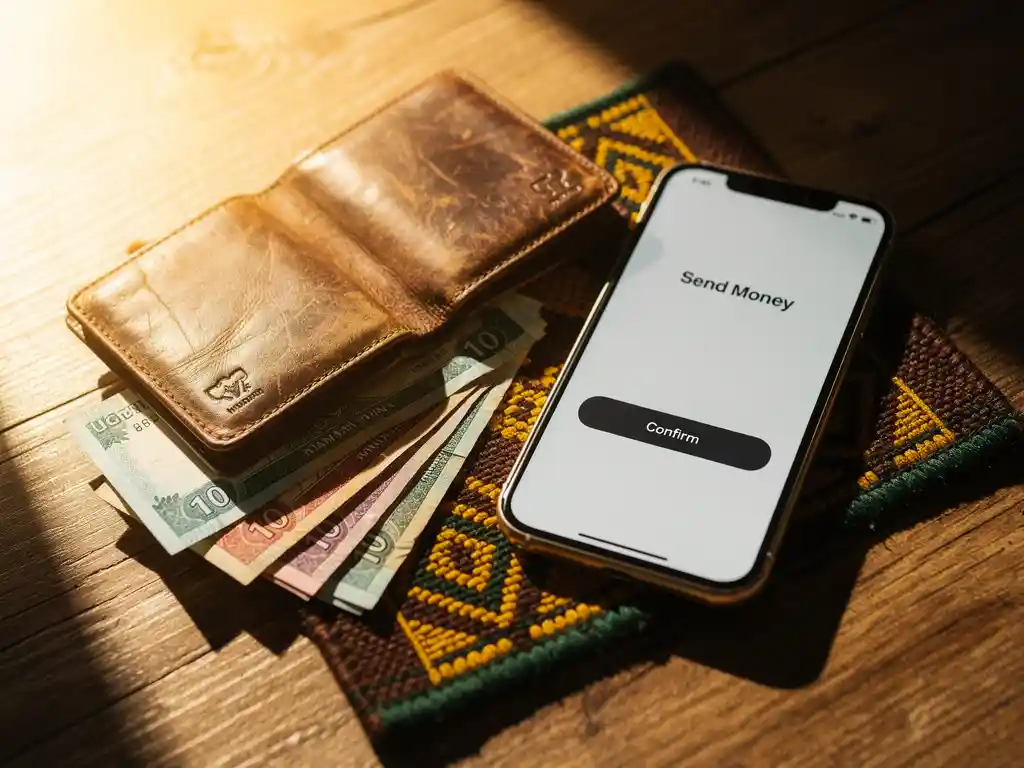
To avoid poor exchange rates when sending money to Uganda, compare providers before every transfer and always check the mid-market rate as your benchmark. The biggest losses come from providers who offer “zero fees” but embed wide margins into the exchange rate itself. Below, we break down every factor that affects the rate you get, so you can keep more money in your family’s hands.
What causes exchange rates to vary between money transfer providers?
Exchange rates vary between providers because each company sets its own markup on top of the mid-market rate, which is the real, interbank rate at which currencies are actually traded. This markup is how most providers make their profit, and it can range from a fraction of a percent to several percentage points, meaning two providers sending the same amount to Uganda can deliver very different sums to the recipient.
Several factors drive how large that markup becomes:
- Business model: Providers that charge an upfront fee often apply a smaller exchange rate margin. Those advertising “no fees” typically recover costs through a wider rate spread.
- Transfer corridor: Less commonly served routes, including some African corridors, can attract higher margins because competition is lower.
- Transfer volume: Some services offer better rates for larger amounts, so sending a bigger sum occasionally can be more efficient than smaller, frequent transfers.
- Payment method: How you fund the transfer (bank account, debit card, credit card) affects the total cost and sometimes the rate offered.
- Operational costs: Providers with large physical agent networks pass some of those costs to users through the exchange rate.
Understanding these dynamics puts you in control. When you know where the margin hides, you can compare providers on a like-for-like basis rather than being misled by headline numbers.
What is the mid-market rate and why does it matter for Uganda transfers?
The mid-market rate, also called the interbank rate or real exchange rate, is the midpoint between the buy and sell prices of two currencies on the global foreign exchange market. It is the rate banks use when trading with each other, and it represents the fairest possible conversion value. For Uganda transfers, it matters because it is the baseline against which every provider’s rate should be measured.
No retail provider passes on the mid-market rate without any margin, but knowing it tells you exactly how much a provider is charging you in hidden exchange rate costs. If the mid-market rate for euros to Ugandan shillings is, say, 1 EUR to 4,200 UGX, and a provider offers you 1 EUR to 3,980 UGX, that gap is their profit taken directly from your transfer.
You can check the mid-market rate for free on Google, XE.com, or any financial data site before you send. Use it every time as your reference point. The closer a provider’s rate is to this figure, the better the deal you are getting. Even a 1% difference on a 500 EUR transfer means your family receives noticeably less on arrival.
Which money transfer services offer the best rates to Uganda?
The services that consistently offer the most competitive rates to Uganda are those built around transparent, low-margin pricing models rather than legacy bank infrastructure. Digital-first providers generally outperform traditional banks and high-street money transfer shops because their lower overhead costs allow them to pass savings on to users.
When evaluating any provider for Uganda transfers, look for these qualities:
- Published exchange rate margin: The best providers show you exactly how their rate compares to the mid-market rate before you commit.
- All-in cost display: A trustworthy service shows the total your recipient will receive before you confirm, including all fees and rate margins combined.
- Delivery speed options: Faster delivery sometimes costs more. Knowing your options helps you choose the right balance.
- Recipient payout methods: Mobile money, bank deposit, and cash pickup availability in Uganda affect which provider works best for your specific situation.
- Multilingual support: If you prefer to manage your transfer in Hausa, Amharic, Arabic, or another language, choose a platform that supports you fully in that language.
We built our money transfer service around exactly these principles. Every transaction shows you the real cost upfront, with no hidden charges buried in the rate. And because everything in our app can be used in your local language, including Tigrinya, Hausa, Amharic, French, and more, you always know what you are agreeing to.
What hidden fees should you watch out for when transferring money?
The most common hidden fees in international money transfers are exchange rate markups, recipient bank fees, intermediary bank charges, and corridor-specific surcharges. These costs rarely appear on the headline pricing page, yet they can significantly reduce the amount that arrives in Uganda.
Exchange rate margin disguised as a “free” transfer
The most widespread hidden cost is the exchange rate margin. A provider advertising zero transfer fees almost always compensates by offering a worse exchange rate than the mid-market rate. The fee is still there. It is simply invisible unless you compare against the real rate.
Recipient-side and intermediary charges
Even when your sending fee looks low, the recipient’s bank or mobile money provider may deduct a charge on arrival. Intermediary banks, which sometimes process transfers between institutions, can also take a cut mid-route. Always ask whether the amount shown is guaranteed to arrive, or whether it is the amount sent before any deductions.
Other fees to watch for include:
- Credit card funding surcharges (often 1.5% to 3% on top of the transfer cost)
- Cancellation or amendment fees if you need to change a transfer
- Minimum transfer thresholds that force you to send more than you intended
- Weekend or off-hours rate adjustments, where providers apply a wider margin when markets are closed
Does the transfer method affect the exchange rate you get?
Yes, the method you use to fund your transfer directly affects the total cost and, in some cases, the exchange rate you receive. Providers treat different funding sources differently, and those differences show up in what your recipient ultimately receives.
Paying by bank transfer or direct debit is almost always the cheapest funding method. It carries the lowest processing cost for the provider, and those savings are typically reflected in the rate or fee structure. Debit card payments are slightly more expensive but still reasonable. Credit card payments are the most costly option, often attracting a surcharge of several percent that can wipe out any rate advantage you gained by choosing a competitive provider.
The delivery method on the Uganda side also plays a role. Mobile money transfers, which are widely used across Uganda, are often processed quickly and at low cost. Bank deposits may take longer and occasionally attract recipient-side fees depending on the institution. Cash pickup through agent networks can be convenient but sometimes comes with a slightly less favorable rate to cover the physical infrastructure cost.
Choosing bank-to-mobile-money transfers, where available, is often the most cost-effective combination for sending money to Uganda.
When is the best time to send money to Uganda for a better rate?
The best time to send money to Uganda for a better exchange rate is during active foreign exchange market hours on weekdays, typically between Monday and Friday when both European and African financial markets are open. Exchange rates fluctuate continuously, and providers often widen their margins during weekends or public holidays when the underlying market is less liquid.
While timing the market perfectly is not realistic for most people, a few practical habits can help you get a consistently better rate:
- Avoid weekends and public holidays: Many providers apply a less favorable rate when interbank markets are closed, knowing customers have fewer alternatives.
- Send during overlapping market hours: When European and East African business hours overlap, rates tend to be more competitive.
- Monitor rate trends briefly: If you are not in a rush, checking the EUR/UGX or GBP/UGX rate over a few days can reveal whether you are sending at a relatively strong or weak moment.
- Use rate alert tools: Some transfer platforms let you set a target rate and notify you when it is reached, removing the guesswork.
- Consolidate transfers: Sending one larger amount monthly rather than several small amounts reduces the cumulative impact of fees and rate margins.
Consistency matters more than perfection. Building a routine around weekday transfers and comparing two or three providers each time will deliver better results over a year than trying to time the perfect moment.
How FroggyTalk helps you send money without losing on exchange rates
We created FroggyTalk because we know what it means to send money home and worry whether your family is receiving what you actually sent. Our international money transfer service is built for African diaspora communities across Europe who want transparency, reliability, and genuine respect for their money.
Here is what makes our approach different:
- No hidden fees: We show you the full cost before you confirm, including the exchange rate and any applicable charges, so there are no surprises on arrival.
- Competitive exchange rates: We keep our margins low and our pricing honest, because we believe your family should receive as much as possible.
- Multilingual support: Everything in our app can be navigated in your language, whether that is Hausa, Amharic, Tigrinya, Arabic, French, or several others. You should never have to guess what you are agreeing to.
- Seamless experience: Manage your calls and your transfers in one place, through a platform built specifically for communities like yours.
- Real-time tracking: Know exactly where your transfer is at every step, from the moment you send to the moment it arrives.
You deserve to feel heard, seen, and noticed, not just as a customer, but as someone whose connection to home matters. Whether you need to pay bills for family abroad or send regular support, we are here to make it straightforward and fair. Contact us to learn more or get started today.
Frequently Asked Questions
How do I know if I'm getting a fair exchange rate for my Uganda transfer?
The simplest way is to look up the mid-market rate on Google or XE.com before you send, then compare it directly to the rate your provider is offering. Calculate the difference as a percentage — anything above 2–3% is a significant margin worth shopping around to reduce. The most reliable providers will show you this comparison themselves, displaying exactly how their rate stacks up against the real market rate before you confirm.
What's the minimum amount worth sending to Uganda to make the fees worthwhile?
This depends on the provider’s fee structure, but as a general rule, fixed fees hurt small transfers the most. If a provider charges a flat €3 fee on a €30 transfer, that’s already a 10% cost before the exchange rate margin is even considered. For small amounts, look for providers with percentage-based fees or no fixed fees at all. For regular senders, consolidating into one larger monthly transfer is almost always more cost-efficient than several smaller ones.
Can my recipient in Uganda receive money directly to their mobile money account, and which networks are supported?
Yes, mobile money delivery is widely available for Uganda and is often the fastest and most cost-effective payout method. Major networks like MTN Mobile Money and Airtel Money are supported by most reputable digital transfer providers. Always confirm with your chosen provider which networks they support before sending, and check whether your recipient’s account is active and verified to avoid delivery delays.
What should I do if my transfer to Uganda is delayed or the wrong amount arrives?
First, check your transfer tracking information — most digital providers offer real-time status updates that can clarify whether the transfer is still in transit or has been delivered. If the amount that arrived is less than expected, ask your provider for a full cost breakdown, as recipient-side bank fees or intermediary deductions may be the cause. If the issue isn’t resolved quickly, escalate through the provider’s official support channel and keep a record of your transaction ID and all correspondence.
Is it safe to use a digital money transfer app instead of a traditional bank for sending money to Uganda?
Yes, provided the provider is properly licensed and regulated in the country where you are sending from. Reputable digital transfer services operating in Europe are required to be registered with financial regulators such as the FCA in the UK or relevant authorities in EU member states, and they apply the same anti-fraud and data protection standards as banks. Always verify a provider’s regulatory status before using them, and avoid any service that cannot clearly show you who oversees their operations.
How do exchange rate alert tools work, and are they actually useful for Uganda transfers?
Rate alert tools let you set a target exchange rate — for example, a specific EUR/UGX value — and the platform notifies you by email or push notification when the market reaches that level. They are genuinely useful if you have some flexibility about when you send and want to avoid transferring during a weak rate period. Some transfer platforms include this feature natively, while standalone tools like XE Currency Alerts can also be used independently of any specific provider.
Are there any transfer limits I should be aware of when sending money to Uganda?
Most providers impose both minimum and maximum transfer limits, which vary by platform, payment method, and your verification level. Unverified accounts typically have lower limits, so completing full identity verification (usually a government-issued ID and proof of address) unlocks higher thresholds. For larger transfers, some providers may also request source-of-funds documentation as part of standard compliance checks — this is normal and protects both the sender and recipient.